The muffle furnace is one of the oldest instruments in the laboratory and still one of the most used. Nearly every materials, ceramics, metallurgy, battery and pharmaceutical laboratory has one, usually in a corner, usually running a program somebody set up years ago.
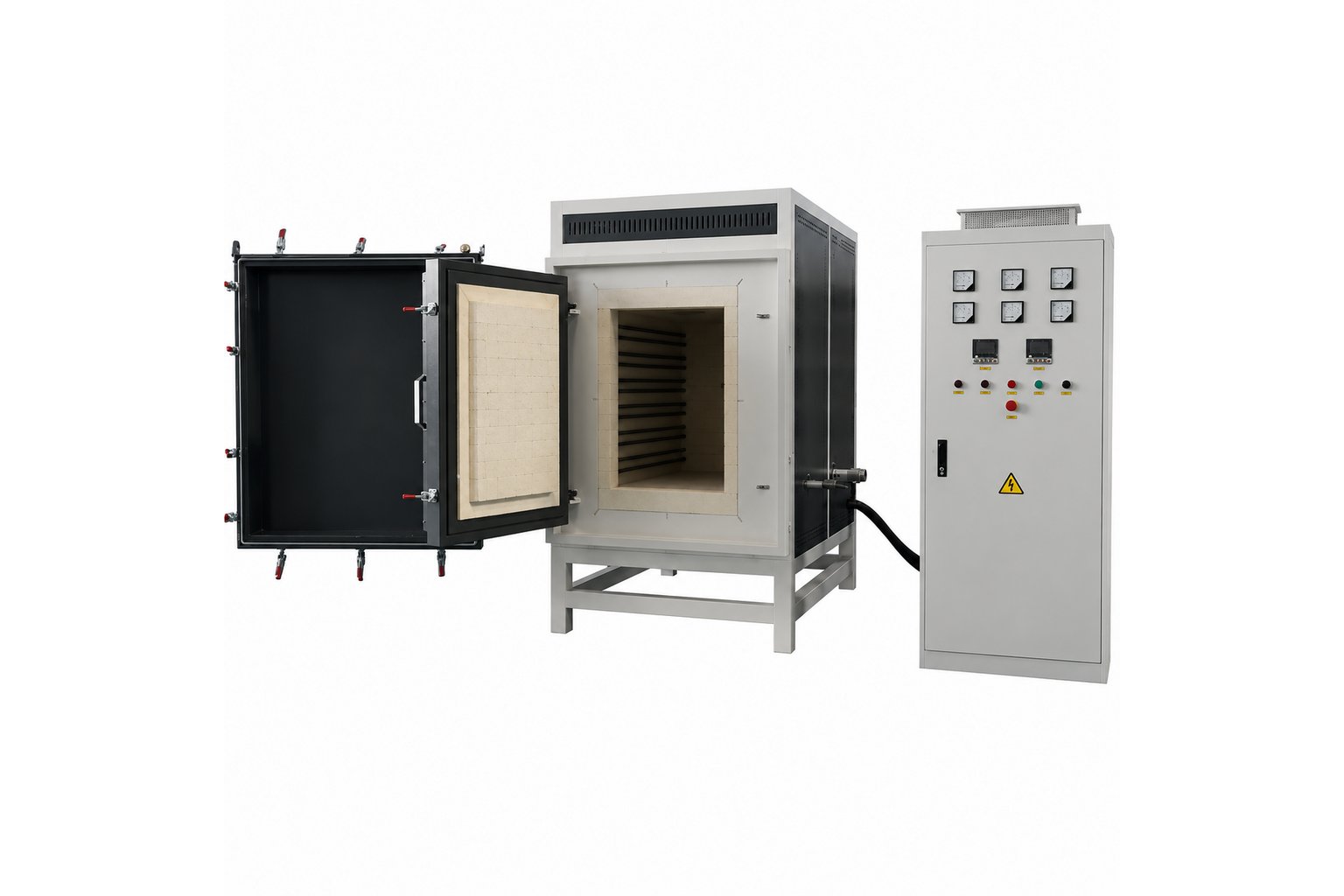
Krivalis supplies the MC series muffle furnace at up to 1200°C in 2, 7 and 16 litre chamber sizes, with a ceramic liner, ±1°C control accuracy and a heat-up time under 30 minutes when empty. This guide explains what a muffle furnace is, how to choose one, and how to keep it accurate.
What Makes a Furnace a Muffle Furnace
The word muffle refers to the inner chamber that separates the sample from the heat source. In a muffle furnace the heating elements are embedded in or wound around a ceramic muffle, and the sample sits inside that muffle. The sample therefore sees radiant heat from the chamber walls rather than direct contact with an element, and it is protected from contamination by element materials and, in fuel-fired versions, from combustion products.
The practical consequences are uniformity and cleanliness. A well-designed muffle heats its whole chamber to a similar temperature, so a crucible placed anywhere inside sees substantially the same conditions, and the sample is not exposed to the atmosphere of a burner. That is what makes the design suitable for ashing, where the sample must be oxidised cleanly without contamination.
Construction
- Chamber: A ceramic liner inside low-thermal-mass ceramic fibre insulation. The fibre keeps heat-up fast and the outer case cool; the liner protects the insulation and the elements from spills and from the sample.
- Heating elements: Resistance wire, usually an iron-chromium-aluminium alloy, embedded in the chamber walls on multiple faces so that heating is even rather than one-sided.
- Door: Hinged or sliding, with a latch and usually a safety switch that removes power to the elements when the door opens.
- Controller: A PID controller with a thermocouple input, driving a solid-state relay or contactor.
- Case: Sheet steel with ventilation to keep the outer surfaces within touch-safe limits.
Temperature Classes and Heating Elements
Furnaces are broadly classified by maximum temperature, and the element material changes with the class. This matters when specifying, because the elements determine the atmosphere the furnace can tolerate as well as the maximum temperature.
- Up to 1200°C: Iron-chromium-aluminium resistance wire, embedded in ceramic. The general-purpose laboratory class, and the class the MC series belongs to. Robust, inexpensive to re-element, and tolerant of air atmospheres.
- 1200 to 1400°C: Silicon carbide elements. Can run hotter, but are more brittle and more expensive to replace.
- 1600 to 1700°C: Molybdenum disilicide elements. High temperature but sensitive to certain atmospheres and to thermal shock when cold.
The step from 1200°C to 1400°C is larger than it looks. Elements cost more, insulation must be better and element life becomes shorter. If the process genuinely runs at 1150°C, a 1200°C furnace is comfortable; if it runs at 1250°C, a 1200°C furnace is being abused and will consume elements.
The Controller and the Thermocouple
The controller is where most of the useful capability sits. A basic unit holds a setpoint; a good one runs ramp-and-soak programs with several segments, so that a sample can be heated at a controlled rate, held, cooled slowly and held again.
Controlled ramp rates are not a luxury. Many ceramics and glasses crack when heated or cooled too fast, and many sintering processes depend on a specific heating rate as much as on the final temperature. A furnace that can only step to a setpoint will produce cracked samples and inconsistent results.
The thermocouple type must match the temperature range. Type K is common up to about 1200°C, type N is more stable at high temperature, and types S, R and B are used above 1400°C. Thermocouples drift with use — particularly type K, which suffers from oxidation and from the notorious green-rot phenomenon in reducing atmospheres — so a furnace that reads accurately when new may be tens of degrees out after a year of running at high temperature.
Atmosphere: What a Muffle Furnace Cannot Do
A standard muffle furnace runs in air, and that is its fundamental limitation. The resistance elements are exposed to the chamber atmosphere and will oxidise rapidly, or be chemically attacked, in anything other than air or a mildly oxidising environment.
The consequences to be aware of:
- Inert gas: Do not simply purge a muffle furnace with nitrogen and expect good element life. The elements are designed to operate with an oxide skin that forms in air; in inert atmosphere they degrade differently and may fail unpredictably.
- Reducing atmospheres: Hydrogen, carbon monoxide and cracked ammonia attack the elements and the insulation. Use a tube furnace or a dedicated atmosphere furnace.
- Vacuum: A muffle chamber is not a vacuum vessel. Use a vacuum furnace.
- Organic vapours and fumes: Ashing plastics, rubbers and biological samples releases aggressive vapours that attack elements and insulation. Vent the furnace to an extraction system, and expect shorter element life.
If the process needs a controlled atmosphere, the correct tool is a tube furnace or a vacuum atmosphere furnace, not a muffle. Choosing the wrong furnace type is the most expensive mistake in this category.
Choosing a Chamber Size
The MC series is offered in 2, 7 and 16 litre chambers, with 1.5, 3 and 6 kW of power respectively.
- 2 L: Individual crucibles, small samples, ashing and ignition tests. Fast to heat and economical to run.
- 7 L: Multiple samples at once, small batches, general laboratory work. The usual choice for a shared laboratory.
- 16 L: Larger crucibles, bulk calcination and sintering, or samples that need physical space between them to avoid cross-contamination.
Sizing is about usable volume, not nominal volume. A 2 litre chamber holding one large crucible has almost no free space, and placing samples close together compromises uniformity and risks cross-contamination. Leave a clear margin around and above each crucible.
Check the electrical supply as well. A 6 kW furnace needs a supply sized for it, often a dedicated circuit, and should not share a circuit with other high-draw equipment.
Loading and Operating Practice
- Use the right crucible: Alumina, porcelain, quartz or nickel depending on temperature and chemistry. A crucible that softens or reacts with the sample will ruin both.
- Do not overfill: Leave headspace for expansion and for the volume change during ashing.
- Place samples centrally: The hottest and most uniform zone is in the middle of the chamber. Samples near the door or the walls see different conditions.
- Ramp rather than step: Heat at a controlled rate, especially for ceramics and for large or thick samples.
- Open the door hot only when necessary: Every door opening dumps heat, stresses the elements and the insulation, and creates a burn hazard. Have a plan before you open it.
- Cool in the furnace where the process allows: Controlled cooling is part of the thermal cycle. Quenching from temperature may be what the metallurgy requires, but it should be a deliberate decision.
- Use tongs and heat-resistant gloves: Crucibles at 1000°C do not look different from crucibles at 100°C.
Typical Applications
- Ashing and loss on ignition: Destroying organic matter to determine inorganic residue, in food, feed, plastics and environmental samples.
- Calcination: Driving off carbonates, hydrates and volatiles to form an oxide, as in catalyst preparation and cement analysis.
- Sintering: Densifying ceramic and metal powder compacts below their melting point.
- Annealing and stress relief: Softening metals and glass and relieving internal stress after forming or machining.
- Battery materials: Calcining cathode precursors, where the temperature profile strongly influences the crystal structure and performance.
- Heat treatment and testing: Small-scale hardening, tempering and thermal cycling of coupons.
Uniformity, Calibration and Verification
The controller measures one point — wherever the control thermocouple sits. The temperature the sample sees may differ, particularly near the door, near the elements and when the chamber is heavily loaded.
Two checks are worth doing. First, a single-point verification against a calibrated thermocouple placed next to the sample tells you the offset between the reading and reality. Second, a uniformity survey with several thermocouples distributed through the chamber tells you how much the temperature varies across the working volume, which is often more than users assume.
For regulated work — pharmaceutical ashing, accredited testing — these checks form part of the calibration and qualification record, and the interval should be set from observed thermocouple drift rather than from habit.
Maintenance
- Heating elements: The consumable item. Elements age, become brittle and eventually fail open circuit. Replace as a set, since mixed old and new elements heat unevenly and load the controller.
- Thermocouple: Drifts silently. Replace on a schedule or when verification shows an offset that cannot be trimmed out.
- Chamber liner: Inspect for cracks and for spills. A cracked liner lets sample material into the insulation, which degrades performance and can cause a short circuit.
- Door seal and latch: A worn latch lets heat escape and creates a cold spot at the front of the chamber and a burn risk at the case.
- Insulation: Over time, spillage and thermal cycling reduce its effectiveness. Rising power consumption for the same program is the symptom.
- Ventilation: Keep the rear vents clear and the surrounding space free. A furnace pushed against a wall runs hotter than it should.
Safety
A muffle furnace is a 1200°C object with a door on the front. The hazards are burns, fire from combustible samples or vapours, and electrical faults in a hot, dusty environment.
- Never place combustible solvents or materials inside or on top.
- Vent fumes to extraction. Ashing plastics and biological material produces smoke and aggressive vapours.
- Treat every surface as hot. The case remains hot long after the controller reads low.
- Do not defeat the door switch. It is there to remove power when the chamber is open.
- Do not leave unattended overnight unless the installation is designed for it, with alarms and suitable fire separation.
Conclusion
A muffle furnace is simple in concept and easy to misuse. Choose the temperature class honestly against the real process, size the chamber by usable volume rather than nominal litres, respect the atmosphere limits of an air furnace, and treat the thermocouple and elements as consumables on a schedule. A furnace maintained that way will hold its accuracy for years; one that is run at its limit and never verified will quietly deliver wrong results.
Krivalis supplies the MC series muffle furnace at up to 1200°C in 2, 7 and 16 litre chambers, together with tube, chamber, bottom-loading and vacuum atmosphere furnaces for controlled-atmosphere work. Contact our team to match a furnace, controller and crucible set to your thermal process.