Borosilicate glass reactors solve the visibility problem up to about 10 bar. Above that, the material runs out of strength, and chemists who need to see inside a reaction are left with two options: a steel vessel with a small window, or a reactor built from a single crystal.
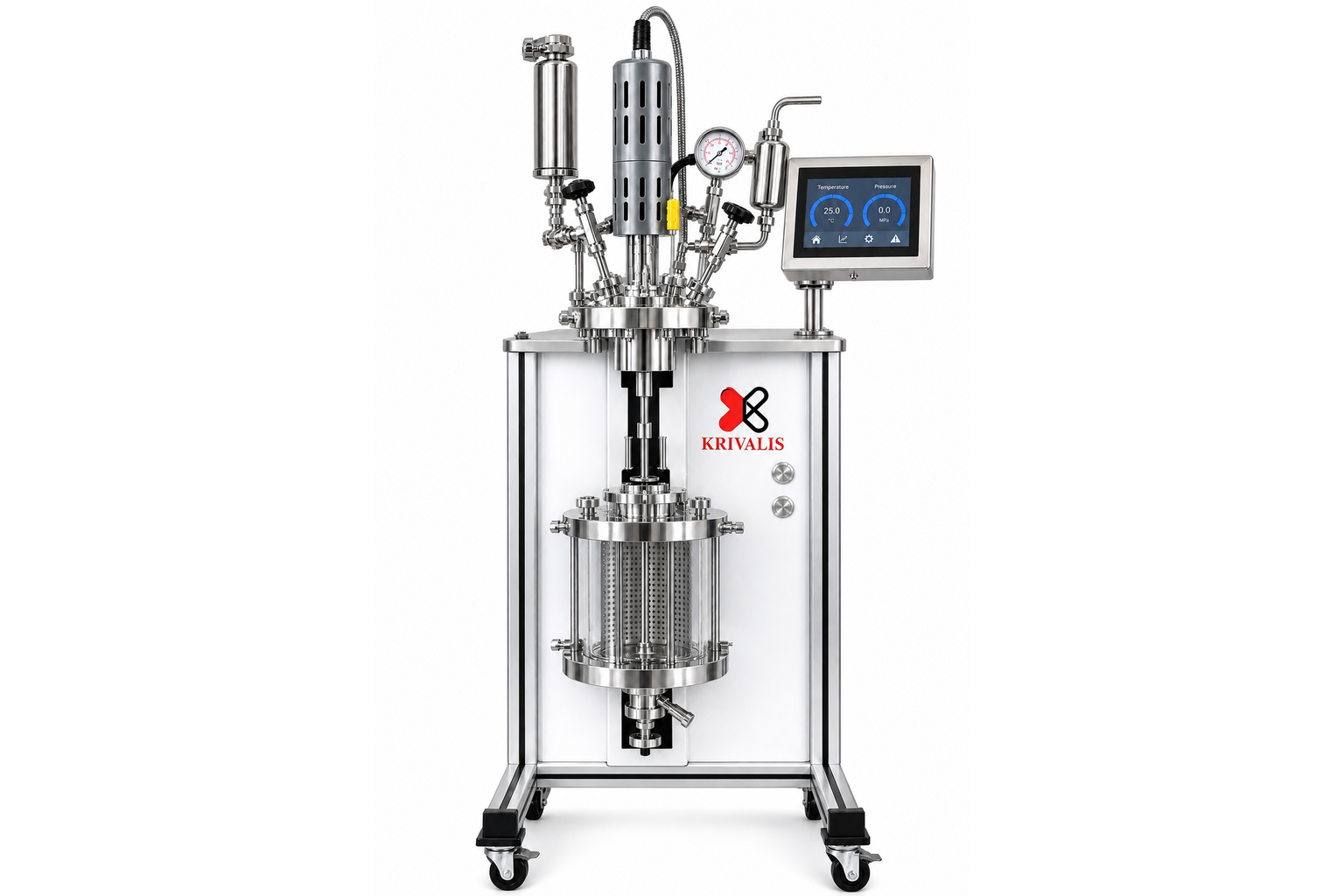
Krivalis supplies glass pressure reactors in quartz, rated to 100 bar, and in sapphire, rated to 200 bar. Both operate to 250°C, both are available from 25 ml to 1000 ml, and both are supplied with a touch panel offering remote monitoring and control. This guide explains what each material offers, why the volumes are necessarily small, and where these reactors earn their price.
Three Materials, Three Different Jobs
It helps to place the three transparent reactor materials side by side, because they are not interchangeable and the choice is usually obvious once the requirement is written down.
- Borosilicate 3.3: 1 L to 100 L, up to 10 bar, up to 220°C. Amorphous, inexpensive, easily formed into large vessels. Excellent for process development at moderate pressure.
- Fused quartz: 25 ml to 1000 ml, up to 100 bar, up to 250°C. Amorphous silica of very high purity, transmitting well into the ultraviolet.
- Sapphire: 25 ml to 1000 ml, up to 200 bar, up to 250°C. Single-crystal aluminium oxide, extremely hard and strong in compression, transmitting from the near ultraviolet to the mid infrared.
The pattern is clear: as the pressure rating rises, the maximum volume falls. This is not a manufacturing limitation that will be engineered away. It follows directly from the mechanics of a pressurised cylinder.
Why High Pressure Optical Reactors Are Small
The hoop stress in a thin-walled pressure vessel rises with diameter for a given wall thickness and pressure. To hold 200 bar, the wall must either be thick relative to the bore or the bore must be small. Thick walls defeat the purpose, since they absorb light and distort the optical path, so high pressure optical reactors are built with small bores and proportionally thick walls.
There is a second reason. Optical measurements need a defined path length and a clean, undistorted window. A 25 ml cell gives a short, well-controlled path through a thick, flat crystal face. A 1 litre vessel at the same pressure would need a wall thick enough to distort the image and to make the seal very difficult to load evenly.
The practical result is that sapphire and quartz reactors are analytical instruments first and process vessels second. They are used to measure and observe, not to make product at scale.
What Sapphire Gives You
Sapphire is single-crystal aluminium oxide. Its hardness is around 9 on the Mohs scale, second only to diamond, which makes it dramatically more resistant to scratching and abrasion than any glass. Because surface flaws are what initiate fracture in brittle materials, a scratch-resistant window is also a stronger window, and this is a large part of why sapphire reaches 200 bar where quartz reaches 100.
Sapphire transmits from roughly 190 nm in the ultraviolet through the visible and out to about 5.5 µm in the mid infrared. That window is unusually wide, which makes sapphire the natural choice when the same cell has to serve UV spectroscopy and infrared or Raman work.
The material is also chemically robust, resisting attack by almost all acids and by hot alkali, with the notable exception of hydrofluoric acid and hot concentrated phosphoric acid. It is, however, expensive, and it is brittle — hardness protects against abrasion but not against impact or point loading.
What Quartz Gives You
Fused quartz is amorphous silicon dioxide of very high purity, typically above 99.9 per cent. Its transmission extends further into the ultraviolet than sapphire, usefully from around 180 to 200 nm depending on grade, which matters for photochemistry driven by short-wavelength lamps and for UV absorption measurements.
The more important advantage in many syntheses is chemical purity. Quartz contains far lower levels of alkali and transition metal ions than borosilicate glass, so it does not leach contaminants into the reaction. For trace-metal-sensitive work — semiconductor precursors, catalyst studies, polymerisation where residual metals affect the product — this is decisive.
Quartz also has a very low coefficient of thermal expansion and excellent thermal shock resistance, and it tolerates temperatures well beyond the 250°C rating of the reactor. Its weakness is mechanical: it is more susceptible to scratching and to fracture from surface flaws than sapphire, which is reflected in the lower pressure rating.
Sealing a Crystal Vessel
The seal is the hardest engineering problem in these reactors. Both sapphire and quartz are far harder than the metals and polymers they are clamped against, and their expansion coefficients differ from those of the surrounding hardware. A metal fitting tightened directly against a crystal face concentrates stress at the contact line and will eventually crack it.
Good designs therefore use a compliant intermediate — usually a PTFE or elastomer seal in a groove — to distribute the load and to accommodate differential expansion, with the clamping force applied through a ring that spreads it over a defined area. The lesson for users is simple: follow the manufacturer torque figures and assembly sequence exactly, and never substitute a harder or thicker seal for the one specified. A seal that is too thick will not seat; one that is too hard will crack the crystal.
Where These Reactors Earn Their Cost
- In-situ spectroscopy: UV-visible absorbance, Raman and infrared measurements taken while the reaction is running at pressure, rather than by sampling and quenching.
- Photochemistry: Reactions driven by UV or visible light, where the vessel must transmit the excitation wavelength as well as allow observation.
- Supercritical fluid work: Supercritical carbon dioxide and water studies, where phase boundaries must be seen to be believed and where pressures of 100 to 200 bar are normal.
- Hydrothermal and solvothermal synthesis: Crystal growth and nanomaterial synthesis under pressure, where nucleation and growth are followed optically.
- Crystallisation and phase studies: Direct observation of nucleation onset, polymorph transitions and phase separation at pressure.
- Kinetics and mechanism: Absorbance against time at controlled pressure and temperature, giving rate data without sampling artefacts.
The common thread is that a sample taken from a high pressure reaction is no longer at high pressure. If the species of interest only exists under pressure, or relaxes within milliseconds of depressurisation, then only an in-situ optical measurement will see it — and that is the case these reactors are built for.
Handling and Maintenance
- Inspect before use: Check the optical faces for chips, edge damage and star cracks. A flawed crystal should be retired, not rotated into service.
- Clean gently: Warm water with a mild detergent, then a solvent rinse. Never use abrasive powders or metal scrapers; hardness protects sapphire against scratching but not against a careless scrape on a quartz face.
- Avoid point loads: Do not rest the vessel on a hard edge, and do not store fittings loose inside it.
- Handle with gloves: Fingerprints on an optical face are a contamination source and, on a hot vessel, a burn hazard.
- Use the specified seal: Replace seals at the interval recommended, and keep spares. A hardened seal is a cracked vessel waiting to happen.
- Respect thermal ramp rates: Even with good thermal shock resistance, do not move a hot vessel to a cold surface or quench it.
Safety
A 200 bar crystal vessel stores a great deal of energy, and its failure mode is energetic fragmentation. Operate behind a shield, wear eye protection, and never leave a pressurised vessel unattended. Fit a relief device, and make sure the relief path is rated for the full pressure of the gas supply rather than for the vessel.
Because these reactors are usually small, it is tempting to treat them as low-risk. They are not. The stored energy depends on pressure and volume together, and 200 bar in a 25 ml cell is still enough to cause serious injury.
Conclusion
Sapphire and quartz reactors occupy a narrow but important niche. They trade volume and cost for the ability to see and measure a reaction at pressure, and in that niche there is no substitute. Choose quartz for ultraviolet transmission and chemical purity, sapphire for the highest pressure and the widest optical range, and treat the seal and the crystal faces as the precision components they are.
Krivalis offers the Glass Pressure Reactor — Quartz at up to 100 bar and the Glass Pressure Reactor — Sapphire at up to 200 bar, both from 25 ml to 1000 ml at up to 250°C with touch panel control and remote monitoring. For moderate pressure work in larger volumes, the borosilicate range covers 1 L to 100 L at up to 10 bar.