Ask an engineer what limits a high pressure reactor and the answer is usually the vessel wall. In practice, the seal is more often the weak point. A reactor body is designed with a generous safety margin and then a few grams of polymer or graphite are asked to hold the same pressure across a bolted flange, at temperature, in contact with whatever solvent the chemist chose that week.
Gasket selection therefore deserves more thought than a part number. This guide covers the three gasket types Krivalis supplies for high pressure reactor and flange service — PTFE, expanded graphite and spiral wound metal — and the installation practice that decides whether any of them works.
What a Gasket Actually Has To Do
A gasket does four things at once, and a material is usually good at two or three of them:
- Conform: Flow into the surface roughness and out-of-flatness of both flange faces under bolt load.
- Seal: Maintain contact stress above the internal pressure at every point of the sealing face.
- Resist extrusion: Stay in the flange gap without being squeezed out under pressure and temperature.
- Recover: Spring back when the joint cools, the bolts relax or the pressure cycles, instead of opening a leak path.
PTFE conforms superbly and recovers poorly. Graphite resists temperature and extrusion superbly and is mechanically weak on its own. A spiral wound gasket adds a steel spring to a soft filler precisely to get recovery and extrusion resistance at the same time.
The Bolted Joint Is a System
Gasket pressure ratings are quoted for an ideal joint. Real joints lose bolt load in three ways: friction under the nut and in the threads, relaxation of the gasket itself after the first thermal cycle, and differential expansion between bolt, flange and gasket as the joint heats.
This is why a joint that seals at 25°C can weep at 200°C, and why re-torquing after the first thermal cycle is standard practice on high temperature flanges. It is also why lubricated threads are specified: most of the torque applied to a dry bolt goes into friction rather than into compressing the gasket.
PTFE Flange Gaskets
PTFE is the default choice for aggressive chemistry at moderate pressure. The Krivalis PTFE flange gasket is available in 1.5 mm (1/16 in) and 3.0 mm (1/8 in) thicknesses, from DN10 to DN100, to ASME B16.21, and is rated to 40 bar over a remarkable range of −268°C to +260°C.
That temperature window is why PTFE is so widely used — it is one of very few materials that behaves at both cryogenic and near-260°C conditions. It is chemically resistant to almost everything except molten alkali metals, elemental fluorine and some fluorinating agents, and it is non-stick and low friction, which makes flanges easy to open and clean.
The limitation is mechanical. PTFE creeps under load: it cold-flows slowly out of the flange gap, particularly at elevated temperature, and once it has flowed it does not spring back. This sets the practical pressure ceiling, and it is why PTFE gaskets should be treated as single-use. A re-used PTFE gasket has already lost the thickness it needs to seal.
Use PTFE when: the chemistry is aggressive, the temperature is below about 200°C for continuous service, and the pressure is moderate.
Expanded Graphite (Grafoil) Gaskets
Expanded graphite foil, usually supplied with a perforated stainless steel insert for handling strength and blow-out resistance, is the workhorse of high temperature, high pressure sealing. Krivalis supplies metallic Grafoil gaskets in 1.0, 1.5, 2.0, 3.0 and 4.0 mm thicknesses, in 1500 × 1500 mm and 1000 × 1000 mm sheets, rated to 500 bar and from −240°C to +550°C, with higher pressures achievable using reinforcement.
Graphite has no melting point and does not creep in the way PTFE does, so it holds bolt load far better at temperature. It also conducts heat well — useful for heating a flange evenly — and is self-lubricating, so it releases cleanly. Its resistance to most chemicals is excellent, with the important exceptions of strong oxidisers such as hot concentrated nitric acid and peroxides.
The trade-offs are practical. Graphite is friable and the sheet edges damage easily, so it must be cut and handled with care. On its own it has little mechanical strength — hence the metal insert — and it should not be used in oxidising service. Graphite also has a slightly higher minimum seating stress than PTFE, so the flange and bolt size must be able to deliver it.
Use graphite when: the temperature exceeds PTFE limits, the pressure is high, or the process cycles thermally and needs a seal that recovers.
Spiral Wound Metal Gaskets
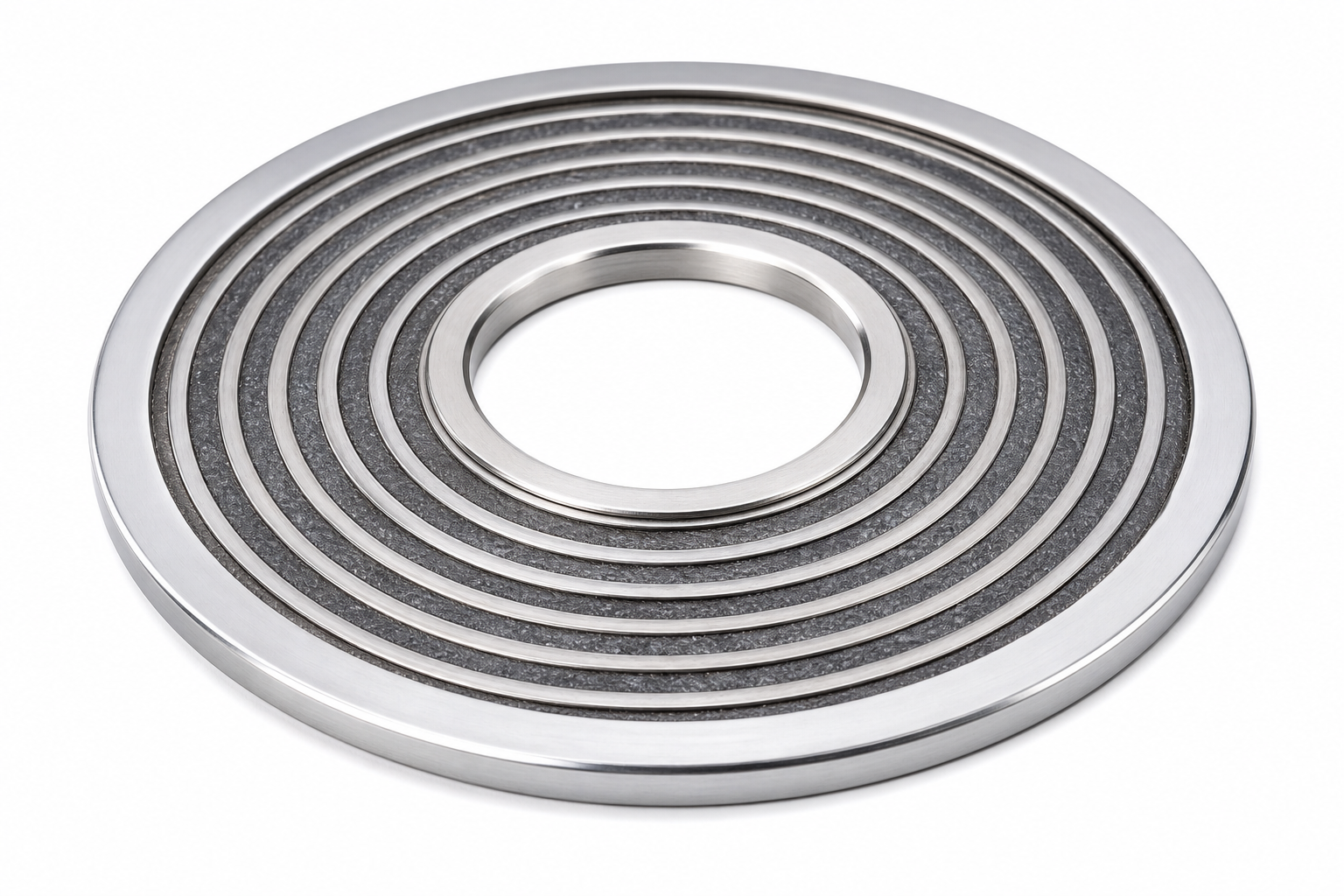
A spiral wound gasket is a V-section strip of stainless steel alternated with a soft filler, wound into a ring and finished with inner and outer retaining rings. The steel provides the spring and the extrusion resistance; the filler provides the conformability and the seal.
Krivalis spiral wound gaskets use SS304 or SS316 windings with a graphite or PTFE filler, 4.5 mm thick, from NPS 1/2 in to 24 in and beyond, in pressure classes 150 through 2500, to ASME B16.20. The graphite-filled version covers −200°C to +550°C up to 400 bar, with special designs reaching 1000°C.
The defining characteristic is resilience. Because the steel winding acts as a spring, the gasket continues to push back against the flange as the joint moves, which is why spiral wound gaskets are standard on high pressure flanges that see pressure and temperature cycling. Their blow-out resistance is correspondingly high. The cost is that they are harder to seat — the flange faces must be flat and the bolt load must be sufficient to compress the winding — and they are not reusable.
Use spiral wound when: the flange follows an ASME class pattern, pressures are high, the joint cycles, or you need a defined, verifiable standard rather than a cut sheet.
Selection by Duty
- Moderate pressure, aggressive chemistry, below 200°C: PTFE.
- High temperature, high pressure, non-oxidising: expanded graphite with a stainless insert.
- Class-rated flanges, cyclic service, high pressure: spiral wound, graphite filled.
- Cryogenic service: PTFE at the low end, graphite where thermal cycling is severe.
- Oxidising acids: PTFE; avoid graphite.
For reactor lid closures specifically, the gasket style must match the closure design. A flat lid face that takes a cut gasket is a different joint from a groove that takes an O-ring, and substituting one for the other is a common cause of leaks that get blamed on the gasket material.
Installation: Where Most Failures Begin
- Clean both faces: A single hardened particle under a graphite gasket creates a leak path that no amount of torque will close. Inspect for old gasket residue, scratches and corrosion pitting.
- Check flatness and alignment: Gaskets seal by contact stress, and a cocked flange produces uneven stress no matter how carefully it is torqued.
- Tighten in a cross pattern, in stages: Bring the bolts up to about 30 per cent of final torque, then 60 per cent, then final, moving diagonally. Tightening one bolt fully loads the flange unevenly and can crush one side of the gasket.
- Lubricate the threads: Use the torque figures for lubricated fasteners, or the gasket will be under-compressed and the joint will leak.
- Re-torque after the first thermal cycle: Standard practice on high temperature joints, and often the difference between a joint that holds and one that weeps.
- Do not over-torque: Excess load crushes graphite and extrudes PTFE, and on glass or PTFE-lined equipment it can damage the flange itself.
Common Failure Modes
- Extrusion: Soft gasket forced into the flange gap under pressure; looks like a gasket that has been nibbled at the edges. Fix by reducing the gap or choosing a gasket with a retaining ring.
- Relaxation: Bolt load decays after the first heat-up and the joint starts to weep. Fix by re-torquing, or by choosing a gasket with better recovery.
- Chemical attack: Swelling, softening or embrittlement. PTFE swelling in some halogenated solvents is a classic example.
- Thermal degradation: PTFE above roughly 260°C, or graphite in oxidising service, will fail progressively rather than suddenly.
- Re-use: The most common cause of all. Both PTFE and spiral wound gaskets are single-use items.
Conclusion
A gasket is a consumable that decides whether the reactor is usable on the day. Choose the material by temperature first, then chemistry, then pressure; respect the flange and the torque sequence; and replace rather than re-use. The cost of a gasket is trivial against the cost of a lost batch or an unplanned shutdown.
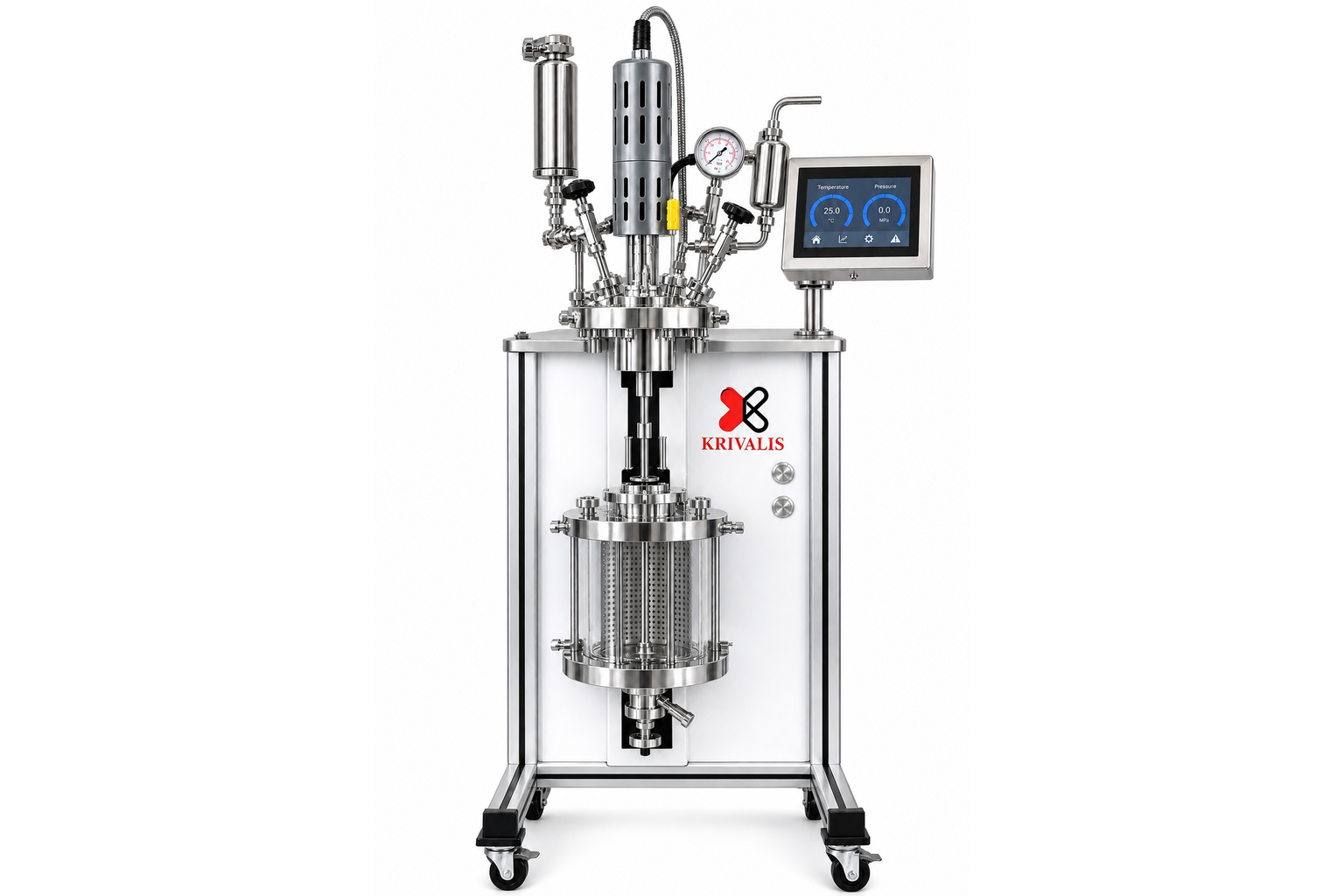
Krivalis supplies PTFE flange gaskets, metallic Grafoil gaskets and spiral wound metal gaskets alongside our reactor range, so the seal can be specified with the vessel rather than after it. Contact our team for help matching a gasket to your operating conditions.