
Sapphire Glass Reactor Buying Guide
1. What Sapphire Is For
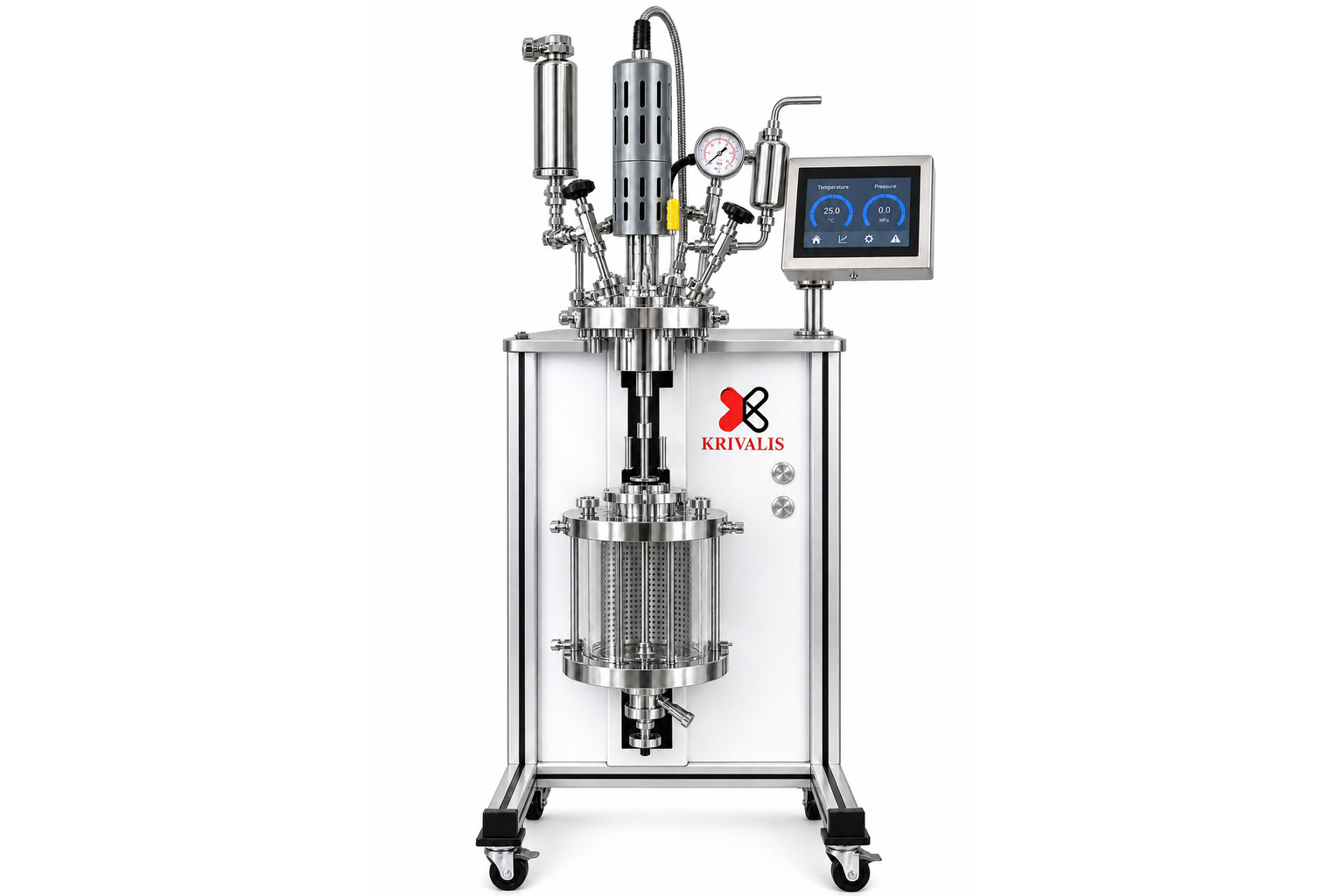
Sapphire is single-crystal aluminium oxide. In reactor service it offers the highest pressure rating of the transparent materials – 200 bar – combined with the widest optical transmission window, from roughly 190 nm in the ultraviolet through the visible and out to about 5.5 µm in the mid infrared. Our sapphire reactors run from 25 ml to 1000 ml at up to 250°C, with touch panel control and remote monitoring.
If 100 bar and deep-UV transmission are enough, a quartz reactor will usually cost less. Sapphire earns its premium when you need the extra 100 bar, the infrared range, or the hardness.
2. Why Sapphire Reaches 200 bar
Two properties combine. First, single-crystal alumina is exceptionally strong in compression and can be fabricated with a thick wall relative to a small bore. Second, it is extremely hard – around 9 on the Mohs scale, second only to diamond – so it resists the surface scratches that initiate fracture in brittle materials. Because a scratch-free window is a stronger window, hardness is not just a durability advantage; it is a direct contributor to the pressure rating.
The volume limit follows from the same mechanics as quartz. Hoop stress rises with diameter, and a thick wall intended to hold 200 bar would absorb and distort light. Sapphire reactors are therefore built small by necessity, and they are best understood as analytical instruments rather than production vessels.
3. The Optical Window
Sapphire transmits from about 190 nm through the visible and into the mid infrared to roughly 5.5 µm. This unusually wide window is why sapphire is the natural choice when the same cell must serve UV-visible spectroscopy and infrared or Raman work without changing the vessel.
Confirm the exact transmission requirement against the grade offered, and remember that the optical path is only as good as the seal geometry: a distorted or over-constrained window will ruin the measurement even with a perfect crystal.
4. Chemical Compatibility
- Excellent: Almost all acids, including hydrofluoric acid in dilute or short exposures where quartz and borosilicate would be destroyed. Hot alkali resistance is also good.
- Watch: Hot concentrated phosphoric acid can attack sapphire at elevated temperature.
- Note: Sapphire is chemically more robust than quartz across the board, which widens the range of chemistries that can be run in a transparent vessel.
As always, confirm compatibility for every wetted component, not just the crystal – the seals and the metal fittings are usually the first to fail.
5. Hardness Is Not Toughness
This is the single most important handling point. Sapphire resists abrasion extremely well, but it is brittle: it will not survive a knock against a bench edge, a dropped fitting, or a point load from an over-tightened clamp. Do not treat hardness as a licence to be careless. The failure mode remains sudden fracture.
6. Sealing and Assembly
The seal is the hardest engineering problem in any crystal reactor, and it is more acute at 200 bar. Sapphire is far harder than the components it is clamped against, and differential expansion as the vessel heats and cools must be absorbed somewhere. Good designs use a compliant PTFE or elastomer seal in a groove, with the clamping force spread over a defined area by a ring rather than applied directly to the crystal face.
- Follow the manufacturer torque figures and the assembly sequence exactly.
- Never substitute a harder or thicker seal for the one specified.
- Keep spare seals and replace them on schedule – a hardened seal is a cracked vessel waiting to happen.
- Re-assemble on a clean, soft surface, never on bare metal.
7. Choosing the Volume
- 25 to 100 ml: Spectroscopy and screening, particularly where sample quantity is limited.
- 200 to 500 ml: The working size for supercritical fluid studies, hydrothermal synthesis and crystallisation work.
- 1000 ml: The practical maximum where more material or longer residence time is needed.
8. Applications That Justify Sapphire
- Supercritical carbon dioxide and water: 100 to 200 bar, where phase boundaries must be seen directly.
- Combined UV-vis and IR/Raman: The wide transmission window allows several techniques in one cell.
- Hydrothermal crystal growth: Nucleation and growth followed optically under pressure.
- Photochemistry and photolysis: Where the excitation wavelength lies in the near ultraviolet.
- Corrosive high-pressure chemistry: Where a transparent vessel must also survive aggressive media.
- Polymorph and phase studies: Direct observation of transitions at pressure.
9. Instrumentation
Sapphire reactors are supplied with a touch panel offering remote monitoring and control, with online pressure display, magnetic stirring and overpressure protection. Because the vessels are small and often used for measurement rather than production, the quality of the pressure and temperature instrumentation usually matters more than the throughput – a reading that drifts will invalidate the experiment long before the reactor itself becomes a limitation.
10. Safety
- Operate behind a shield and wear eye protection. 200 bar in a crystal vessel stores enough energy to cause serious injury.
- Never leave a pressurised vessel unattended.
- Fit a relief device rated for the gas supply pressure, not merely the vessel rating.
- Retire any crystal with a chip, edge damage or star crack.
- Do not quench a hot vessel or rest it on a cold surface.
11. Sapphire, Quartz or Borosilicate?
- Borosilicate 3.3: 1 L to 100 L, up to 10 bar, 220°C. General-purpose process development at moderate pressure. Cheapest per litre by a wide margin.
- Quartz: 25 ml to 1000 ml, up to 100 bar, 250°C. Deep UV transmission and the highest chemical purity.
- Sapphire: 25 ml to 1000 ml, up to 200 bar, 250°C. Highest pressure, widest optical range, greatest hardness and broadest chemical resistance.
The decision is usually made for you once the maximum pressure and the measurement wavelength are written down.
Krivalis supplies sapphire glass pressure reactors from 25 ml to 1000 ml at up to 200 bar and 250°C, with touch panel control and remote monitoring. Contact our team for a configuration matched to your pressure, wavelength and chemistry.