
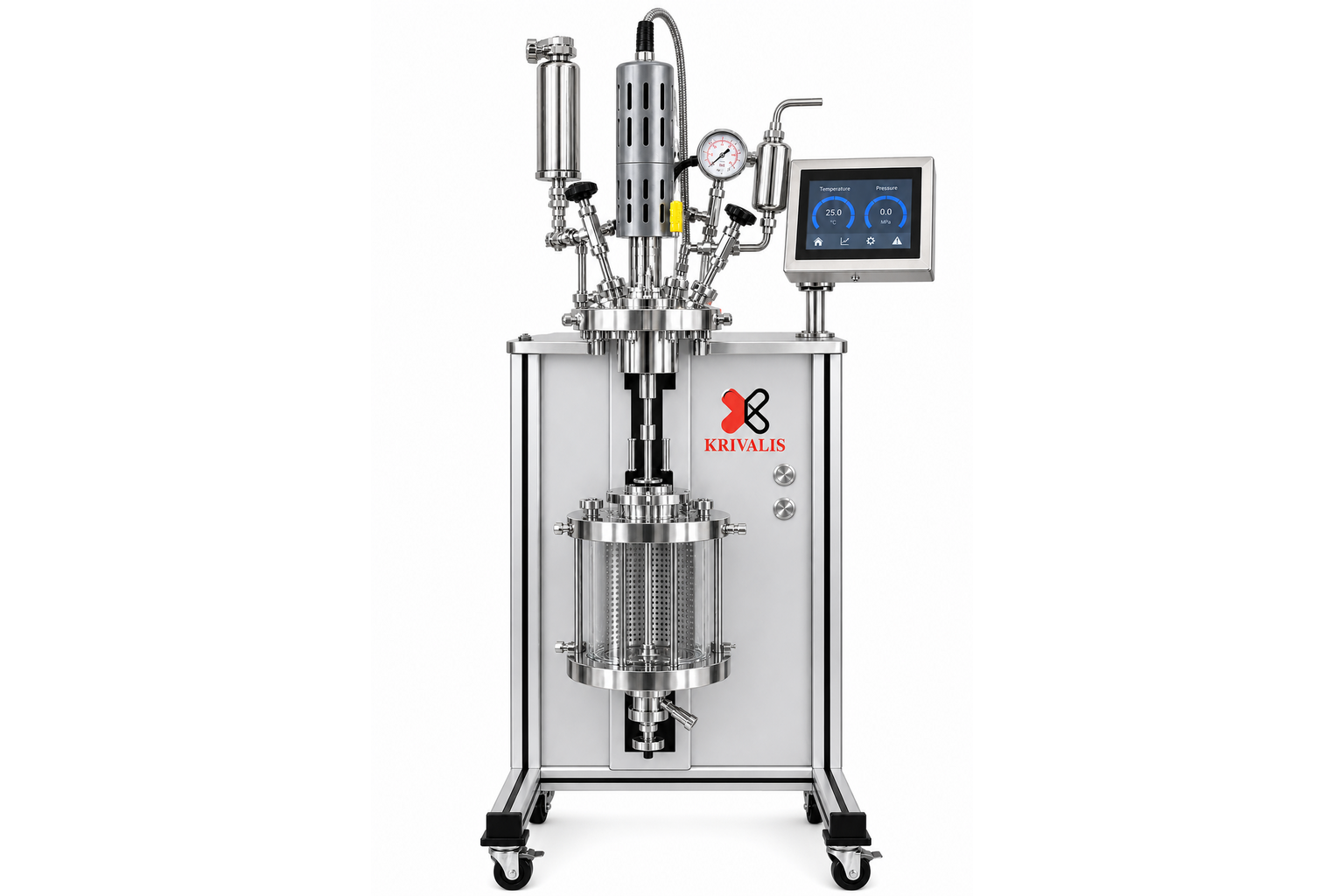
Quartz Glass Reactor Buying Guide
1. What Quartz Is For
Fused quartz is amorphous silicon dioxide of very high purity, typically above 99.9 per cent. It occupies a specific niche: high-pressure reactions that need to be seen, measured, or irradiated in the ultraviolet, and where metal contamination of the product is unacceptable. Our quartz reactors are rated to 100 bar and 250°C, in volumes from 25 ml to 1000 ml.
If the process only needs visible observation at moderate pressure, a borosilicate reactor is cheaper, larger and more robust. Quartz earns its cost in two specific ways: optical transmission deep into the ultraviolet, and chemical purity.
2. UV Transmission – The Defining Advantage
Quartz transmits usefully from around 180 to 200 nm depending on grade, where borosilicate cuts off near 300 nm. This matters in two situations. In photochemistry driven by short-wavelength lamps, the vessel wall must pass the excitation wavelength or the photons never reach the reaction. In UV absorption measurements taken through the vessel, the measurement window has to extend below where the analyte absorbs strongly.
Confirm the transmission grade before ordering. Different quartz grades have different hydroxyl contents and different deep-UV cut-offs, and the cheapest grade is not always the one that transmits at the wavelength that matters to you.
3. Chemical Purity – The Second Advantage
Quartz contains far lower levels of alkali and transition metal ions than borosilicate glass. Because it does not leach contaminants into the reaction, it is the material of choice for trace-metal-sensitive work: semiconductor precursors, catalyst studies where residual metals poison the result, and polymerisation where metal residues affect the product.
If your specifications include a metals limit on the final product, this is often the deciding factor rather than the optical properties.
4. Understanding the 100 bar Limit
Hoop stress in a pressurised cylinder rises with diameter for a given wall thickness, so a vessel that must hold 100 bar needs a wall thick relative to its bore. A thick wall absorbs light and distorts the optical path, which defeats the purpose of a transparent vessel. This is why high-pressure optical reactors are built small – 25 ml to 1000 ml – and why the volume cannot simply be scaled up.
Quartz is mechanically weaker and more susceptible to fracture from surface flaws than sapphire, which is reflected in the lower pressure rating. Quartz also has a very low coefficient of thermal expansion, giving excellent thermal shock resistance, and it tolerates temperatures well beyond the 250°C reactor rating.
5. Chemistry Compatibility
- Excellent: Most aqueous acids (except HF), organic solvents, oxidising agents, halogens at moderate temperature.
- Attacked: Hydrofluoric acid, hot concentrated phosphoric acid, strong hot alkali.
- Watch: Alkaline solutions at elevated temperature etch quartz progressively, which weakens the vessel and roughens the optical face.
6. The Seal Is the Hard Part
Quartz is far harder than the metals and polymers it is clamped against, and its expansion coefficient differs from the surrounding hardware. A metal fitting tightened directly onto a quartz face concentrates stress at the contact line and will eventually crack it. Good designs use a compliant PTFE or elastomer seal in a groove to distribute load and accommodate differential expansion, with clamping force spread over a defined area.
The practical consequence for the buyer: follow the manufacturer torque figures and assembly sequence exactly, and never substitute a harder or thicker seal for the one specified. A seal that is too thick will not seat; one that is too hard will crack the vessel. Keep spares on the shelf.
7. Choosing the Volume and Geometry
- 25 to 100 ml: Spectroscopy and screening, where only a small charge is available or where the optical path length must be short and defined.
- 200 to 500 ml: The usual working size for hydrothermal and solvothermal synthesis and for crystallisation studies.
- 1000 ml: The practical maximum, for processes needing more material or a longer residence time.
8. Applications That Justify Quartz
- In-situ UV-visible spectroscopy: Absorbance measured while the reaction runs at pressure, rather than by sampling and quenching.
- Photochemistry: UV-driven reactions where the vessel must transmit the excitation wavelength.
- Supercritical fluid studies: Supercritical carbon dioxide and water work, where phase boundaries must be seen.
- Hydrothermal and solvothermal synthesis: Crystal growth and nanomaterial synthesis followed optically.
- Kinetics and mechanism: Rate data taken without sampling artefacts, for species that only exist under pressure.
9. Handling and Maintenance
- Inspect the optical faces before every run for chips, edge damage and star cracks. A flawed vessel should be retired.
- Clean gently – warm water with mild detergent, then a solvent rinse. No abrasive powders, no metal scrapers.
- Avoid point loads. Do not rest the vessel on a hard edge or store fittings loose inside it.
- Handle with gloves – fingerprints are a contamination source, and a hot vessel is a burn hazard.
- Respect thermal ramp rates. Good thermal shock resistance is not a licence to quench a hot vessel on a cold bench.
- Replace seals on schedule, and keep a spare vessel if the work is time-critical.
10. Safety
A 100 bar crystal vessel stores a great deal of energy and fails by energetic fragmentation. Operate behind a shield, wear eye protection, never leave a pressurised vessel unattended, and fit a relief device rated for the full pressure of the gas supply rather than for the vessel. Small volume does not mean low risk – stored energy depends on pressure and volume together, and 100 bar in a 25 ml cell is still enough to cause serious injury.
11. Quartz or Sapphire?
Choose quartz when you need the deepest ultraviolet transmission and the highest chemical purity, at pressures up to 100 bar. Choose sapphire when you need 200 bar, the widest optical range (near UV through mid IR), or the greatest resistance to scratching. Both cover 25 ml to 1000 ml and up to 250°C, and both are supplied with touch panel control and remote monitoring.
Krivalis supplies quartz glass pressure reactors from 25 ml to 1000 ml at up to 100 bar and 250°C. Contact our team to discuss transmission grade, sealing and instrumentation for your application.