
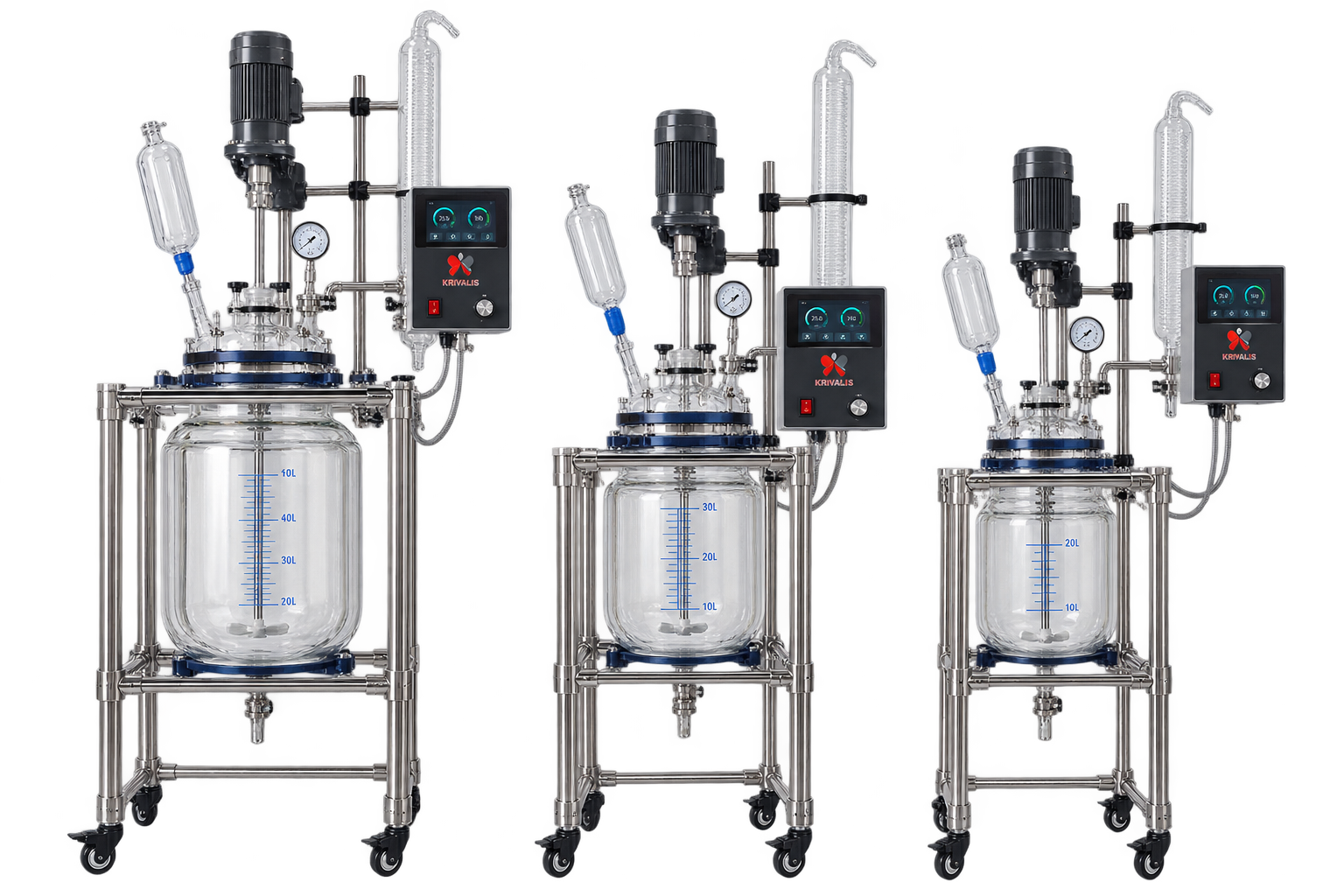
Borosilicate Glass Reactor Buying Guide
1. Start With the Chemistry, Not the Vessel
Borosilicate 3.3 is the right material for the great majority of laboratory chemistry, but it has three genuine enemies: hydrofluoric acid, hot concentrated phosphoric acid and strong hot alkali. If your process involves any of these, stop here and specify a metal vessel instead. Everything else – organic solvents, aqueous acids and bases at moderate temperature, oxidising agents – is handled well.
The 3.3 in the name is the coefficient of thermal expansion, about 3.3 × 10⁻⁶ per kelvin. It is roughly a third that of soda-lime glass, which is why borosilicate tolerates a rapid temperature change of about 100 K while ordinary glass would crack.
2. Confirm the Pressure and Temperature Envelope
Our borosilicate reactors are rated up to 10 bar and 220°C, in volumes from 1 litre to 100 litres. Treat those two numbers as a shared envelope rather than independent limits: glass strength falls as temperature rises, so the full pressure rating is best understood as available at the lower end of the temperature range and de-rated as you approach the maximum.
10 bar covers a surprising amount of useful chemistry – moderate-pressure hydrogenation, hydrogenolysis, carbonylation, solution polymerisation and most autoclave work that does not need high hydrogen pressure. Above that, the correct tool is a sapphire or quartz reactor, or a steel autoclave.
3. Choose the Volume Properly
Plan on a working volume of 50 to 70 per cent of the nominal vessel volume. The remaining headspace is needed for foaming, gas evolution and the vortex thrown up by stirring. Filling a glass vessel to the neck leaves no room for any of these and risks liquid being carried into the condenser.
- 1 to 5 L: Route scouting, small-scale optimisation, teaching.
- 10 to 30 L: The usual working size for process development and kilo-lab batches.
- 50 to 100 L: Pilot demonstration, where heat transfer and mixing begin to resemble production.
4. Decide on Jacketing Early
A jacketed vessel allows heat transfer fluid to be circulated from a heating and cooling circulator, which gives far better control than a heating mantle. Two things are worth knowing before you choose. First, the jacketed glass wall is mechanically weaker than an unjacketed one, so jacketed vessels are usually offered at a lower pressure rating. Second, borosilicate conducts heat far less well than steel, and the wall of a 50 litre vessel is a real thermal resistance – so heat-up and cool-down are slower than the jacket temperature suggests. On an exothermic step, watch the bulk temperature rather than the jacket setpoint.
5. Specify the Lid Ports Generously
Port count is the single most common regret. The lid carries the stirrer, the condenser, a temperature sensor, a gas inlet, a solid addition port and a spare. Instrumentation you add later needs a port, and a vessel built with too few necks cannot be retrofitted cheaply. List every device the process might grow to need – pH probe, sampling valve, pressure transmitter, second condenser – and buy a lid with at least one more neck than you think you need.
6. Agitation: Overhead, Not Magnetic
Glass reactors almost always use overhead mechanical stirring driven from above. Magnetic stirring becomes unreliable at larger volumes and higher viscosities, and the coupling is affected by heating. Overhead drive also allows a wider choice of impeller – anchor and pitched-blade turbines for viscous or solid-laden charges, Rushton turbines for gas dispersion.
Two operating points matter more than they are usually given credit for. Keep the stirrer shaft centred and the drive aligned, because a bent shaft will eventually damage the vessel neck. And run at the lowest speed that achieves the mixing you need: excessive agitation abrades the glass, generates fines in crystallisations, and can pull gas into the liquid when you did not want it.
7. Plan the Wetted Materials
The vessel and lid are borosilicate glass, the seals and gaskets are PTFE, and the stirrer is PTFE-sleeved or PTFE-faced where it contacts the product. This keeps the process in contact with inert surfaces, which matters for trace-metal-sensitive work and for any product where extractables have to be controlled.
8. Instrumentation and Control
Reactor control is offered as an analogue panel or a touch panel. The touch panel version supports remote monitoring and control, multi-segment temperature programming and logging of temperature, pressure and stirring parameters. Programmable ramps make a run repeatable rather than dependent on an operator watching the clock, and logging turns each batch into a record rather than an anecdote.
9. Reflux and Gas Handling
Most glass reactors run with a vertical condenser on one lid neck, and this is where a great deal of operating detail lives. Size the condenser for the reflux ratio and the heat input, or solvent will be lost through the vent and the charge will quietly concentrate.
Never close off the vent simply to reach a pressure target on a vessel that was not designed for it. For gas-consuming reactions, use a gas inlet with flow control and a vent with a relief device. For inert atmospheres, a controlled bleed with a bubbler outlet is simpler and safer than holding a static pressure in glass.
10. Safety, Inspection and Consumables
- Inspect before every run: star cracks, chips at the flange face, scuff marks. Retire a damaged vessel rather than rotating it to the back of the shelf.
- Tighten flange clamps in a cross pattern so the glass is not loaded unevenly.
- Fit a rupture disc or relief valve on the vent path to protect against a runaway or an over-filled vessel.
- Operate behind a polycarbonate shield and wear eye protection. The failure mode of glass is sudden and energetic.
- Keep the flange gasket and seals as consumables. Replace them on schedule; an over-compressed gasket loads the glass unevenly.
- Avoid thermal shock on the jacket – do not step a circulator from 150°C to 5°C in one move on a large jacketed vessel.
11. Summary Checklist
- Chemistry free of HF, hot phosphoric acid and hot alkali.
- Maximum operating conditions inside 10 bar / 220°C with margin, and de-rated at the top of the temperature range.
- Working volume 50–70 per cent of nominal.
- Jacketed if heat transfer control matters; pressure rating checked accordingly.
- Lid with more necks than the current process needs.
- Overhead stirring with an appropriately sized impeller.
- Condenser sized for the reflux duty, and a relief device on the vent.
- Touch panel with programming and logging if runs must be repeatable.
Krivalis supplies borosilicate 3.3 glass reactors from 1 L to 100 L at up to 10 bar and 220°C. Contact our engineering team to configure jacketing, ports, stirring and control for your process.